A hollow-stem auger advances through dense glacial till near the Providence River, and the rig’s rotary head pushes past cobbles dropped by the Laurentide Ice Sheet. We log refusal depth and groundwater elevation before the tendon is placed. In downtown Providence the soil profile shifts abruptly—from granular outwash to very dense lodgement till—within a single city block. That variability governs anchor type selection. The CPT test helps map the transition from fill to natural soils, and the grain size analysis confirms whether the bond zone sits in free-draining or fine-grained material. Providence’s history of mill foundations and buried canal walls adds another layer of complexity. Every anchor design must account for buried obstructions, variable bedrock depth, and the proximity of adjacent structures built in the 19th century.
A passive anchor in Providence till can mobilize 40 kips per linear foot, but only if the bond zone is drilled past the weathered crust and into intact lodgement till.
Our approach and scope
Site-specific factors
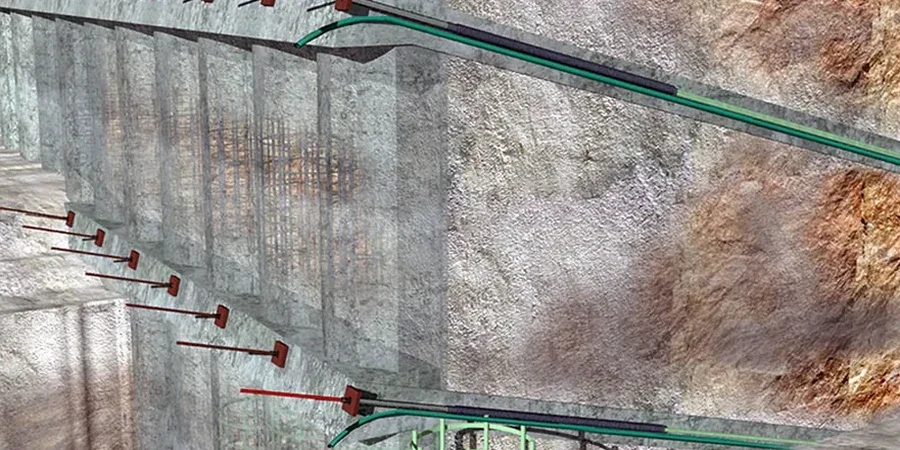
Providence recorded a magnitude 4.7 earthquake in 1940 with an epicenter near the city center. The current USGS seismic hazard maps assign a peak ground acceleration of 0.15g to 0.20g for the 2,475-year return period. Active anchors in a seismic event must accommodate the additional earth pressure without brittle failure. We design the unbonded length to stretch elastically under the seismic increment, preventing load transfer into the grout column that could cause progressive debonding. Corrosion protection is class II for temporary anchors and class I for permanent installations, with double-corrugated HDPE sheathing over the full unbonded length. The marine atmosphere along the Providence waterfront accelerates chloride attack. Anchor heads are recessed, greased, and capped with a steel cover plate. A single failed anchor in a tied-back wall can trigger a progressive collapse—so load cells on selected anchors provide continuous monitoring during the first winter cycle and after any nearby blasting or pile driving.
Relevant standards
IBC Chapter 18 (Soils and Foundations), ASCE 7 Section 12.13 (Seismic Earth Pressure), PTI DC35.1 (Recommendations for Prestressed Rock and Soil Anchors), ASTM A416 (Steel Strand for Prestressed Concrete)
Related services
Anchor capacity design
Calculation of ultimate bond stress from site-specific soil parameters. We use the Littlejohn and Bustamante methods with reduction factors calibrated to Providence till friction angles measured in triaxial testing.
Load testing and verification
Performance tests, proof tests, and creep tests executed with hydraulic jacks and digital dial gauges. Each anchor receives a unique load-displacement curve and lock-off record.
Corrosion protection systems
Class I and II protection detailing per PTI DC35.1. Epoxy-coated bar tendons, double HDPE sheathing, and post-grouting of the trumpet assembly for permanent installations in the marine exposure zone.
Typical parameters
Quick answers
What is the difference between active and passive anchors?
Active anchors are post-tensioned after grouting to a specified lock-off load, which pre-compresses the soil mass and controls wall deflection from the start. Passive anchors are not tensioned; they develop resistance only when the soil begins to move and load is transferred into the bond zone. In Providence, active anchors are preferred for deep excavations adjacent to historic masonry buildings where allowable lateral movement is under 0.5 inches.
How much does anchor design and testing cost in Providence?
The engineering design, load testing, and verification for a tied-back anchor system in Providence typically ranges from US$1.010 to US$3.860 per anchor, depending on whether it is temporary or permanent, the bond length required, and the corrosion protection class specified. Permanent anchors with double corrosion protection and extended free lengths for seismic demand sit at the upper end of that range.
How deep must anchors be installed in Providence soils?
The bond zone must start below the frost line, which in Providence reaches approximately 4 feet. For passive anchors in till, we specify a minimum 10-foot bond length starting at 15 feet below grade. Active anchors require a minimum 15-foot bond zone. The unbonded length extends through the active wedge and into competent material, often placing the bond zone at depths of 25 to 45 feet depending on the excavation height and setback from property lines.