When you dig into Providence's geology, you quickly learn that the city sits on a complex mix of glacial outwash, Narragansett Basin sediments, and urban fill that shifted neighborhoods like Federal Hill over the past century. We see it in the lab every week: a contractor sends over what looks like clean sand from a College Hill excavation, and the full hydrometer test reveals a 22% silt fraction that changes the drainage design entirely. That's the reality of working with Rhode Island soils. A standard sieve stack gets you partway, but ASTM D422-compliant analysis with hydrometer sedimentation is what separates a reliable bearing capacity estimate from a soggy basement six months after the certificate of occupancy. Whether you're placing structural fill near the Woonasquatucket River or characterizing subgrade for a Brown University expansion, the particle size distribution dictates compaction specs, permeability assumptions, and frost susceptibility—and Providence winters don't forgive mistakes on any of those. We run the complete curve from coarse gravel down to the #200 sieve and into the colloidal range, because skipping the fines fraction in this city's till deposits has cost too many projects too much rework. The data feeds directly into USCS classification per ASTM D2487, giving your geotechnical engineer the numbers needed for seismic microzonation assessments when the next New England earthquake cycle raises questions about site class. And for sites where bedrock depth is shallow, pairing grain size data with seismic refraction profiles helps distinguish weathered schist from competent rock before the excavator arrives.
A one-point hydrometer test on Providence glacial till can shift your site class from D to E — and that changes the seismic design category for the entire structure.
Our approach and scope
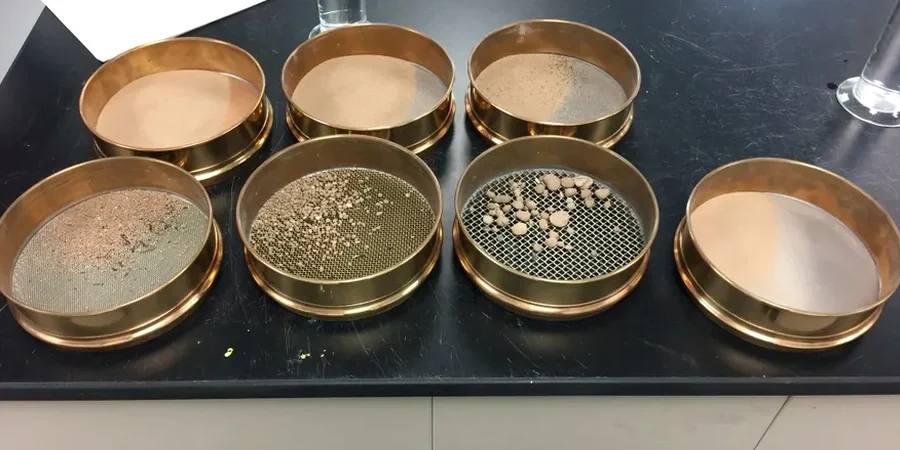
Site-specific factors
We had a project off Allens Avenue where the contractor assumed a uniform fine sand based on visual classification from test pit logs. No hydrometer was run. Eighteen months after construction, a retaining wall showed differential movement, and the forensic investigation revealed interbedded silt seams at 4 and 7 feet depth that had consolidated unevenly under load. The fix cost exceeded six figures. In Providence's estuarine and glacial lake deposits—especially near the Providence River and its buried tributary channels—thin silt and clay layers are common and almost invisible in disturbed samples. A full grain size curve with hydrometer would have flagged the bimodal distribution immediately: the sand fraction plotting at 0.3 mm, the silt at 0.02 mm, with a gap in between that signals a gap-graded soil prone to internal erosion and piping. For deep excavations near downtown where slope stability calculations depend on drained friction angles estimated from gradation, missing the fines content by even 10 percentage points can produce an unconservative factor of safety. The lab data isn't a checkbox for the building department—it's the difference between a foundation that performs and one that becomes a liability.
Relevant standards
ASTM D422 - Standard Test Method for Particle-Size Analysis of Soils, ASTM D2487 - Standard Practice for Classification of Soils for Engineering Purposes (Unified Soil Classification System), AASHTO T 88 - Particle Size Analysis of Soils, IBC Chapter 18 - Soils and Foundations, ASCE 7 - Minimum Design Loads for Buildings and Other Structures (Site Class determination)
Related services
Complete Sieve + Hydrometer (ASTM D422)
Full mechanical sieve stack from 3 inches through No. 200, plus 24-hour hydrometer sedimentation for the minus-200 fraction. Reports D10, D30, D60, Cu, Cc, and percent gravel-sand-silt-clay. Standard turnaround 3–5 days.
Wash Sieve Analysis (No. 200 Wash)
Sieve analysis with pre-wash through the No. 200 sieve to determine total fines content by mass loss. Suitable for granular soils where the fines fraction does not require detailed hydrometer sizing. Same-day results available.
Atterberg Limits + Grain Size Package
Combined liquid limit, plastic limit, and full sieve-hydrometer analysis from one split sample. Provides complete USCS classification with group symbol and group name. Ideal for preliminary foundation reports.
Forensic Gradation & Gap-Grading Analysis
Detailed examination of bimodal or gap-graded distributions for litigation support, retaining wall failure investigations, and filter compatibility studies. Includes coefficient of uniformity and curvature with commentary on internal stability.
Typical parameters
Quick answers
How much does a grain size analysis with hydrometer cost in Providence?
A complete sieve plus hydrometer analysis per ASTM D422 typically runs between US$90 and US$160 per sample at Providence-area geotechnical labs, depending on whether you need standard 5-day turnaround or 24-hour expedited processing. The price includes the full particle size distribution curve, USCS classification per ASTM D2487, and a signed lab report. Bulk pricing is generally available for projects submitting 10 or more samples.
When is a hydrometer test required instead of just a sieve analysis?
A hydrometer is necessary whenever more than 12% of the sample passes the No. 200 sieve, because the sieve stack cannot differentiate silt from clay. In Providence's glacial till and estuarine deposits, we routinely see 15–40% fines, so the hydrometer step is essential for accurate USCS classification, drainage design, and seismic site class determination per ASCE 7.
How long does the full ASTM D422 grain size test take?
The complete test runs approximately 24 to 30 hours from start to final data reduction. The sieve portion takes 2–3 hours including oven-drying and weighing each fraction. The hydrometer sedimentation phase requires readings at specific intervals over a minimum 24-hour period per ASTM D422, plus temperature correction and meniscus adjustment. Standard lab turnaround is 3–5 business days; we offer 24-hour expedited for urgent submittals.
What sample size do you need for a grain size analysis?
For sandy soils typical of Providence outwash deposits, we need at least 500 grams of material. For fine-grained silts and clays from the Narragansett Basin sediments, 200 grams is sufficient. The sample should be representative, bagged to preserve natural moisture if Atterberg limits are also requested, and delivered to our lab within 48 hours of sampling to minimize moisture loss that could affect hydrometer dispersion.