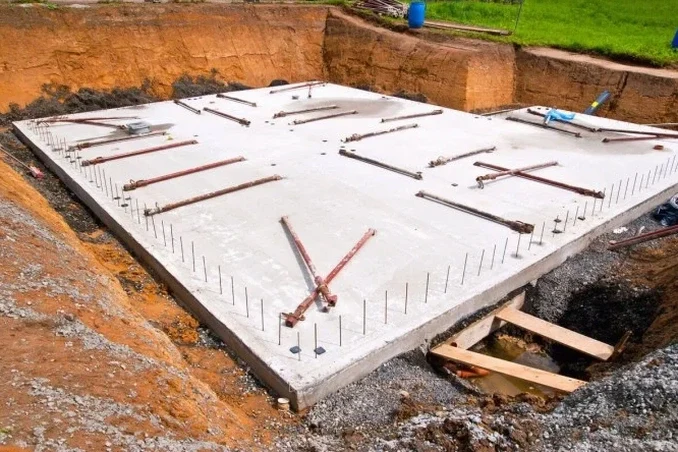
A five-story mixed-use structure going up on Westminster Street hit an unexpected pocket of loose urban fill at just 8 feet down—right where the original footing design assumed competent bearing. The architect called us mid-panic. In Providence, this is more rule than exception. The city sits on a chopped-up blanket of glacial till, outwash, and centuries of man-placed fill, so isolated footings often become a gamble. We moved them to a rigid raft/mat foundation, recalculated total and differential settlement using compressibility parameters from our consolidation tests, and kept the project on schedule. A well-dimensioned mat foundation bridges soft spots that would otherwise require deep piles or extensive over-excavation, distributing column loads across a continuous slab that floats over the variability.
A mat foundation isn't just a thick slab—it's a settlement-control system that negotiates with Providence's erratic glacial legacy one boring log at a time.
Our approach and scope
Site-specific factors
Providence gives you two seasons that punish mat foundations: a wet spring thaw that saturates the upper fill and a freeze-thaw winter that can heave poorly insulated perimeters. The bigger hidden risk, though, is differential settlement across the mat footprint when one corner bears on dense ablation till and the opposite corner sits on compressible estuarine silt—a configuration we see constantly in the Jewelry District and along the Woonasquatucket corridor. Without a site-specific consolidation analysis, the mat behaves like a rigid body that tilts rather than flexes, cracking partition walls and binding elevator rails. We also check liquefaction-induced bearing loss using Seed & Idriss simplified procedure where loose saturated sands appear above bedrock, which isn't rare in the downtown footprint given the city's elevation barely reaches 70 feet above sea level at its highest point.
Video overview
Relevant standards
ASCE 7-22 Minimum Design Loads and Associated Criteria for Buildings and Other Structures, IBC 2021 Chapter 18 Soils and Foundations, ASTM D1586 Standard Test Method for Standard Penetration Test (SPT) and Split-Barrel Sampling of Soils, ACI 318-19 Building Code Requirements for Structural Concrete
Related services
Geotechnical Investigation for Mat Design
SPT borings, CPT soundings, and selective thin-wall Shelby tube sampling to capture undisturbed specimens of Providence's glacially overconsolidated clays and interbedded silts. We log every boring to ASTM D2487 and map fill thickness across the footprint.
Laboratory Consolidation & Shear Testing
One-dimensional consolidation (ASTM D2435) to obtain Cc, Cr, and preconsolidation pressure for each compressible layer, plus consolidated-undrained triaxial (ASTM D4767) where undrained strength controls short-term bearing capacity under the mat.
Typical parameters
Quick answers
What does raft/mat foundation design cost for a typical Providence commercial building?
For a mid-rise commercial structure in Providence, the combined geotechnical investigation and mat foundation engineering analysis typically runs between US$1,100 and US$4,560, depending on the number of borings, lab consolidation tests required, and whether CPT soundings are added to refine the stratigraphic profile.
How do you determine if a mat foundation is necessary instead of isolated footings?
We compare the allowable bearing pressure from the site investigation with the column loads and check total and differential settlement. If footings would exceed 1 inch of total settlement or if more than 30% of the footprint sits on fill or soft silt, a mat foundation usually becomes the more reliable option—especially in Providence where fill thickness can change dramatically within a single city block.
How does Providence's high groundwater table affect mat foundation design?
In much of downtown Providence and the East Side, groundwater appears within 4 to 6 feet of grade. That means we must design the mat for hydrostatic uplift during construction and the service life of the building. We typically specify a buoyancy slab thickness that resists flotation with a minimum factor of safety of 1.2 against the design flood elevation, and we may recommend under-slab drainage or waterproofing systems depending on the use of the basement.
What laboratory tests are most critical for mat foundation settlement analysis?
One-dimensional consolidation tests (ASTM D2435) on undisturbed samples give us the compression index Cc and recompression index Cr that directly feed settlement calculations. For granular layers where undisturbed sampling is impossible, we rely on SPT N-values and CPT tip resistance correlated through Schmertmann's method. We also run Atterberg limits and grain-size analyses to confirm the soil classification before selecting consolidation parameters.