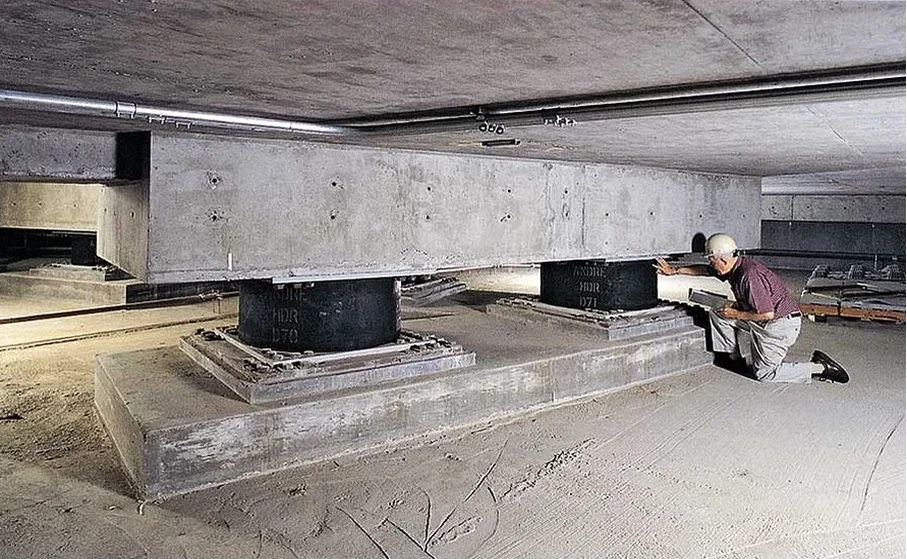
We see it all the time on Providence jobsites. A developer pours money into a beautiful mixed-use building near the Jewelry District, assuming a standard fixed-base foundation is enough because 'Rhode Island isn't California.' Then the geotech report comes back with twenty feet of compressible silt and high groundwater, and suddenly that conventional design won't pencil out for the seismic loads ASCE 7 demands. The mistake isn't the location—it's not evaluating base isolation from the start. Providence sits on the Narragansett Basin, filled with glacial lake deposits and urban fill that amplify ground motion in ways a prescriptive code table won't catch. Our team runs site-specific response analysis to determine if decoupling the structure from the ground is the right move, and we have seen it cut lateral demands by over 60% on projects built over the old buried river channels that crisscross downtown. When the soil profile has a soft clay layer at depth, we often pair the seismic analysis with a deep CPT test to map the impedance contrast that drives amplification.
On Providence's glacial basin soils, a well-tuned isolation system can reduce story accelerations by half, protecting both the structure and what's inside it.
Our approach and scope
Site-specific factors
ASCE 7-22 Section 17 is clear on this: an isolation system must be designed for the Maximum Considered Earthquake, and the moat wall must accommodate the full displacement plus an amplification factor for torsion and accidental eccentricity. In Providence, the risk is not just the design-level shake. It is the thousand-year event hitting the soft soils of the Narragansett Basin and producing a long-duration, low-frequency pulse that a standard fixed-base building transmits straight up through the frame. We have modeled scenarios where a basin-edge effect off the bedrock highs near College Hill concentrates energy into the downtown corridor. Without isolation, non-structural damage alone—ceilings, piping, fire sprinklers—can render a building unusable after a moderate event, even if the steel doesn't buckle. The financial consequence is functional obsolescence: your building stands, but your tenants are out for six months. Isolation cuts that downtime risk dramatically, and for essential facilities like hospitals or data centers, it is often the only way to meet Rhode Island's adoption of the IBC with the seismic design category assigned to the site.
Relevant standards
ASCE 7-22 Minimum Design Loads and Associated Criteria for Buildings and Other Structures, IBC 2021 (adopted by Rhode Island with amendments), ASTM D4015 Standard Test Methods for Modulus and Damping of Soils by Resonant-Column Method, AASHTO Guide Specifications for Seismic Isolation Design (for bridge applications)
Related services
Feasibility and Cost-Benefit Analysis
We compare a fixed-base versus isolated structural scheme early in schematic design, quantifying the reduction in seismic demands, member sizes, and potential tenant downtime for Providence soil conditions.
Nonlinear Time-History Analysis
Site-specific ground motion selection and scaling per ASCE 7-22 Chapter 17, using hazard curves for the Providence 02903 area and 3D structural models in ETABS or SAP2000.
Isolator Specification and Prototype Testing
Performance criteria for lead-rubber or friction pendulum bearings, including prototype test matrices and production testing protocols per ASCE 7-22 Section 17.8.
Peer Review and Building Department Coordination
Presentation of the design basis and analysis results to the Providence Building Department and independent peer review panels, addressing the specific ground conditions of the Narragansett Basin.
Typical parameters
Quick answers
Is base isolation worth the cost for a mid-rise building in Providence?
For a 5- to 10-story building on soft soil (Site Class D or E, common downtown), the isolation system and moat detailing typically add 4% to 7% to the structural frame cost. The return comes from reduced steel tonnage, smaller shear walls, and—most importantly—continued operation after a design-level earthquake. For commercial or institutional owners, that operational continuity often justifies the investment. A full cost-benefit analysis for a Providence project usually runs between US$4,550 and US$7,340 depending on the complexity of the ground motion modeling and the number of isolator types required.
How does Providence's soil profile affect the isolation design?
The Narragansett Basin deposits—glacial lake silts, varved clays, and urban fill—create a strong impedance contrast with the underlying bedrock. This means short-period structures on fixed bases see amplified ground motion, but isolated structures with periods over 2.0 seconds actually benefit because the soft soil filters out the high-frequency energy. We run site-specific response analysis using measured shear wave velocities from downhole or CPT data to confirm the spectral shape, rather than relying on the default site coefficients in ASCE 7.
What kind of testing is required for the isolators?
ASCE 7-22 requires prototype testing of at least two full-scale isolators per type, including thermal loading, aging, and scragging effects. The production test program typically tests 20% of all bearings. For Providence projects, we add low-temperature testing because the bearings can be exposed during winter construction, and the rubber properties shift slightly in cold weather. We specify the test protocol and review the results from the manufacturer.