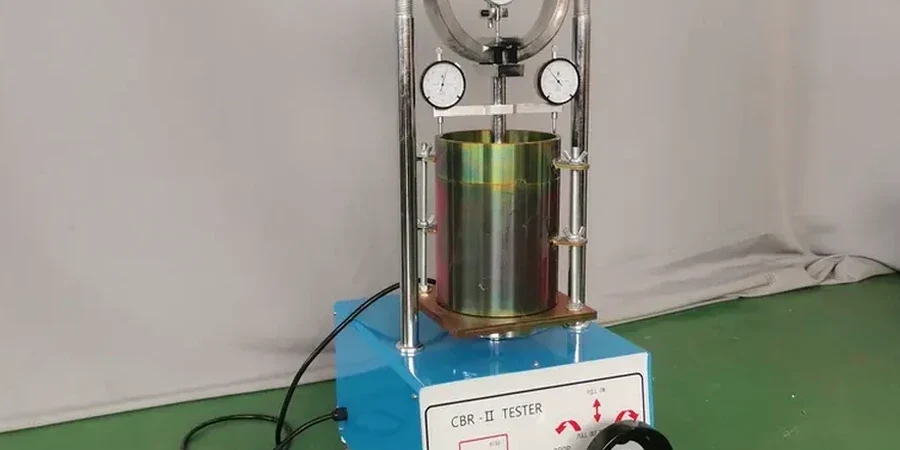
Providence sits on a complicated mix of glacial deposits and filled marshland. The humidity from Narragansett Bay seeps into the subgrade and stays there. A standard pavement design that works fine in Cranston can fail in Fox Point if the bearing ratio wasn't tested under saturated conditions. We have seen cores from the same city block show CBR swings from 3% to 18%. That variability comes straight from the geology. Running a laboratory CBR test on a properly compacted remolded sample tells you what the material can actually support once it's in place and soaked. We complement this with grain size analysis when the gradation looks borderline, and we use Atterberg limits to flag silts that lose strength with moisture before the CBR soak even begins.
A CBR number without a corresponding swell measurement is just half the story. In Providence subgrades, the swell tells you more than the bearing ratio itself.
Our approach and scope
Site-specific factors
The West Side of Providence grew fast during the industrial boom. Mill buildings went up on filled land along the Woonasquatucket River. Today that fill is a grab bag of ash, cinder, brick fragments, and silty dredge. We have cored it. We have tested it. The CBR values in those zones can be as low as 2. The risk is not just rutting. Low bearing soils trap water. That water freezes. Frost action in a saturated subgrade with CBR under 3 will destroy a rigid pavement within five seasons. A laboratory CBR test on these materials, compacted to spec and soaked, gives the design engineer a floor value. From there the pavement section gets thickened or the subgrade gets stabilized. Skipping the test and using a generic assumed CBR of 10 is gambling. In Providence's older neighborhoods, that gamble loses.
Relevant standards
ASTM D1883 - Standard Test Method for California Bearing Ratio (CBR) of Laboratory-Compacted Soils, ASTM D1557 - Standard Test Methods for Laboratory Compaction Characteristics of Soil Using Modified Effort, ASTM D698 - Standard Test Methods for Laboratory Compaction Characteristics of Soil Using Standard Effort, AASHTO T 193 - The California Bearing Ratio
Related services
Standard and Modified CBR with Swell Log
Full 96-hour soak with surcharge. We measure swell at 0, 24, 48, 72, and 96 hours. Load-penetration data is corrected and reported at 0.1 and 0.2 inches. We can run the test on standard or modified Proctor compactive effort depending on the project spec.
CBR on Undisturbed Field Samples
For sites where remolding would misrepresent the in-situ structure, we test undisturbed Shelby tube samples. This is common in Providence's varved silt deposits where the natural lamination controls drainage and strength.
Typical parameters
Quick answers
How long does a laboratory CBR test take in your Providence lab?
The test itself requires 96 hours of soaking under controlled conditions, plus sample preparation and compaction time. From receiving the sample to delivering the report, plan on five to seven working days. We can expedite if the project schedule demands it.
What is the cost range for a single-point CBR test?
A single-point laboratory CBR test with swell measurement and full load-penetration reporting runs between US$120 and US$220, depending on whether we run standard or modified compactive effort and how many points the client needs on the moisture-density curve.
Do you need the soil from our Providence site at a specific moisture condition?
Ideally we receive the bulk sample in sealed bags at its natural moisture content. We will air-dry it in the lab, process it through the appropriate sieve, and then add water back to target compaction moisture. The key is not letting it dry out completely before we get it.
Can you test aggregate base course material for CBR?
Yes. We follow ASTM D1883 and remove particles larger than 19 mm by scalping. If the oversize fraction exceeds 20% of the total mass, we apply a correction to the reported CBR value. For dense-graded aggregate base used in Rhode Island DOT specs, we typically run the test at modified Proctor effort.