Providence's geological patchwork demands more than a standard proctor curve. A site near the Moshassuck River can show compacted granular outwash, while a project up on College Hill runs into dense glacial till with cobbles the size of a fist — both need density verification but behave completely differently under the sand cone. Our field teams have worked these contrasts for years, from Federal Hill brownfield redevelopments to utility trench backfill along Westminster Street, where the water table sits barely four feet down. The sand cone method per ASTM D1556 gives us a direct measurement of in-place density that nuclear gauges often misread in Providence's heterogeneous fills, especially where historic demolition debris laces the upper three to five feet of the profile. Proper compaction control here starts with understanding that the city's average frost depth of 42 inches and seasonal groundwater swings create a compaction window that closes fast, so timing the test right matters as much as running it correctly.
A passing sand cone test in Providence means the fill met spec at that exact point — but only a well-distributed grid of tests gives you the statistical confidence to close a lift.
Our approach and scope
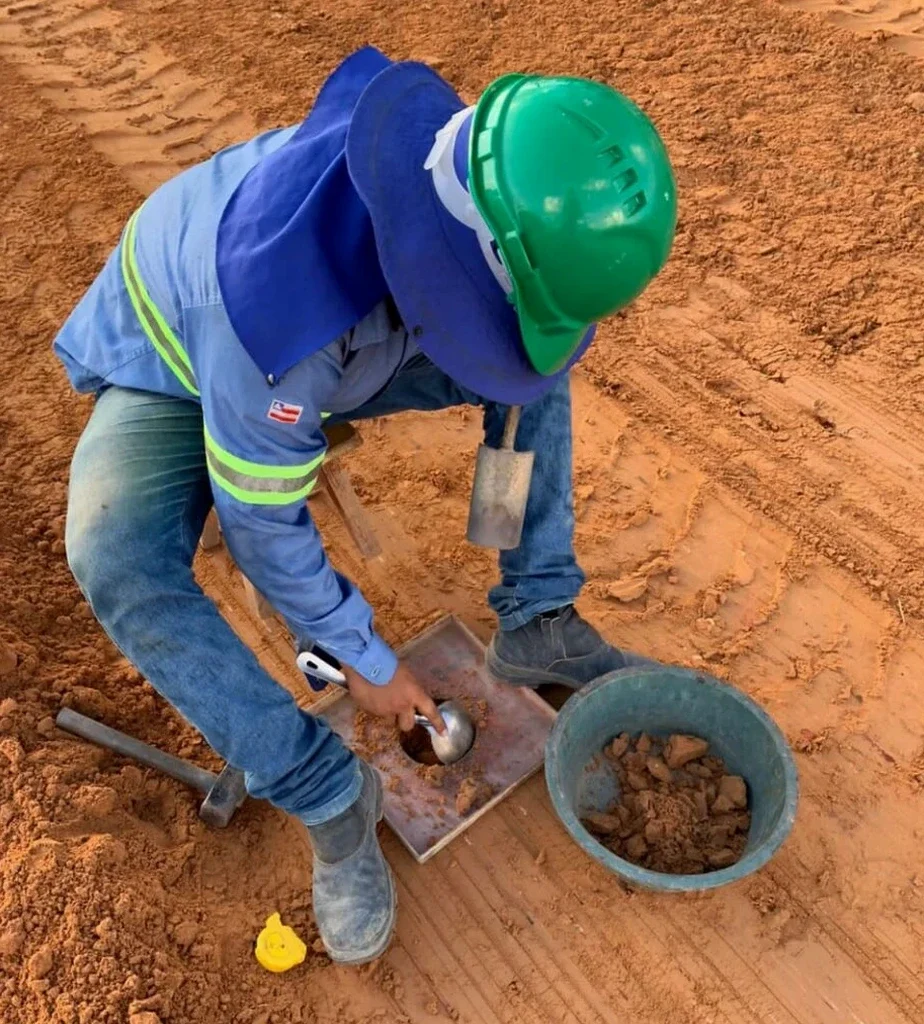
Site-specific factors
Providence's expansion during the 19th-century industrial boom left a legacy of undocumented fill that still shapes geotechnical risk today. Much of the downtown and Jewelry District sits on a layer of coal ash, cinder, and brick rubble that was spread to raise grades above the hurricane-driven storm surge that flooded the Providence River in 1938 and again in 1954. When this fill gets recompacted for modern construction, its density can look acceptable on a sand cone report while hiding organic lenses or voids that settle differentially over time. The real hazard isn't the test procedure — it's relying on too few tests across a site where fill composition changes every 50 feet. We've seen projects where 95 percent compaction was achieved on the north half of a building pad but the south half, underlain by old timber cribbing from a wharf structure, couldn't hold density even after six passes of a vibratory roller. That kind of variability demands a testing frequency that matches the site's history, not just the minimum spec, and it's why we document each sand cone location with photographs and a brief material description on the field log.
Relevant standards
ASTM D1556 — Standard Test Method for Density and Unit Weight of Soil in Place by Sand-Cone Method, ASTM D698 — Standard Test Methods for Laboratory Compaction Characteristics of Soil Using Standard Effort, ASTM D2487 — Standard Practice for Classification of Soils for Engineering Purposes (Unified Soil Classification System), ASCE 7-22 — Minimum Design Loads and Associated Criteria for Buildings and Other Structures (compaction acceptance criteria for seismic site class determination), IBC 2021 (Rhode Island adoption) — Chapter 18 Soils and Foundations; references to compaction control for engineered fill
Related services
Laboratory Proctor Compaction (ASTM D698 / D1557)
The reference curve that every sand cone result is compared against. We run standard Proctor for most building and utility fills, and modified Proctor when the spec calls for higher compactive effort on heavy-duty pavement subgrades.
Nuclear Gauge Density Testing (ASTM D6938)
Faster coverage for large-area fills where the sand cone serves as the referee method. We use the nuclear gauge for production control on highway embankments and warehouse pads, then calibrate against sand cone results every 10 tests.
Rapid Compaction Control (speedy moisture + sand cone)
When the paving crew is waiting and the sun is dropping over Route 95, we combine a speedy moisture test with the sand cone to deliver a percent compaction number within 30 minutes of excavation — enough to sign off a lift before the asphalt goes down.
Typical parameters
Quick answers
What does a sand cone field density test cost on a typical Providence commercial project?
For a standard commercial or residential project in the Providence metro area, a single sand cone test runs between US$90 and US$160 per point, depending on travel distance from the lab and how many points are tested in a single mobilization. A full-day program with 10 to 15 tests spread across multiple lifts typically falls at the lower end of that range per test.
How does the sand cone method compare to a nuclear density gauge for Rhode Island soils?
The sand cone gives you a direct measurement — you physically excavate the soil, weigh it, and measure the hole volume. Nuclear gauges rely on gamma ray attenuation, which gets thrown off by Providence's variable fill materials (especially historic ash and slag layers). On clean granular outwash from the Moshassuck Valley, the two methods track within 1-2 percent. On mixed urban fill, the sand cone is the more reliable number, which is why most Rhode Island geotechnical engineers specify it as the referee method for compaction acceptance.
How many sand cone tests do I need for a building foundation in Providence?
The minimum frequency per IBC and typical Rhode Island project specifications is one test per 2,500 square feet of each compacted lift, or one per 1,500 square feet within the building footprint and within five feet of foundation elements. For a 5,000-square-foot commercial building pad with three lifts of structural fill, expect somewhere between 6 and 10 tests total, distributed across the pad area so every quadrant gets coverage. Sites with variable fill history, like much of downtown Providence, often warrant tighter spacing.
Can you run a sand cone test in wet or frozen ground?
Frozen ground invalidates the test outright — the sand cone method relies on excavating a stable hole, and frozen soil neither excavates cleanly nor represents the density the fill will have after thaw. Wet soil is testable as long as the hole walls stand up and you can capture all the excavated material, but you'll need to oven-dry the sample to get a reliable moisture content. In Providence, where the water table is shallow in the river corridors and spring thaw saturates the upper lifts, we often schedule density testing between mid-morning and early afternoon to let surface moisture drop before cutting the hole.
What's the difference between Standard Proctor and Modified Proctor for compaction acceptance in Rhode Island?
Standard Proctor (ASTM D698, 12,400 ft-lbf/ft³) simulates the compactive effort of older equipment and is the benchmark for most building fills, utility trench backfill, and landscape subgrade in Providence. Modified Proctor (ASTM D1557, 56,000 ft-lbf/ft³) applies roughly 4.5 times more energy and is specified for heavy-duty pavement subgrades under highways like I-95 and I-195, airport runways, and rail corridors. The target percentage is always referenced to the correct Proctor curve — 95 percent of a Modified maximum is a much tougher requirement than 95 percent of a Standard maximum, so confirm which spec applies before testing starts. More info.