The Rhode Island State Building Code, which incorporates IBC 2021 and references ASCE 7-22, mandates rigorous geotechnical investigation for any construction near graded slopes or coastal bluffs. In Providence, where the underlying geology transitions from glacial till to the sedimentary fill of the Narragansett Basin, a slope stability analysis is not a mere formality—it is a critical design input. Our approach integrates subsurface data from SPT drilling to define soil strata and shear strength parameters, providing the factual foundation for limit-equilibrium models. The city's characteristic topography, sculpted by the Moshassuck and Woonasquatucket river corridors, often presents relic landslide features that only a detailed stability assessment can reliably identify before earthwork begins.
A compliant analysis in Providence's glacial till must reconcile IBC minimum factors of safety with the real pore-pressure regimes observed in the Narragansett Basin's interbedded silts.
Our approach and scope
Site-specific factors
Providence sits at the head of Narragansett Bay, with a 2020 census population of approximately 190,000 residents occupying a terrain that rises from sea level to over 200 feet at its highest points. The combination of dense urban infrastructure, aging retaining structures built on compacted fill, and a 247-year seismic record that includes the influence of the Cape Ann fault zone makes slope failures a legacy concern. A sudden loss of toe support from utility excavation or a prolonged wet season that saturates the upper colluvium can reduce the factor of safety below critical thresholds. Integrating a seismic refraction survey into the slope stability analysis allows us to map the depth to bedrock and identify low-velocity zones that correspond to ancient slide planes, a condition that standard borings alone can miss. Without this level of investigation, a developer on Federal Hill or Fox Point assumes a long-term liability that insurance adjusters are increasingly unwilling to underwrite.
Relevant standards
ASCE 7-22 (Minimum Design Loads and Associated Criteria for Buildings and Other Structures), IBC 2021 / Rhode Island State Building Code (Chapter 18 – Soils and Foundations), ASTM D1586 (Standard Test Method for Standard Penetration Test), ASTM D2487 (Standard Practice for Classification of Soils for Engineering Purposes), FHWA NHI-05-123 (Soil Slope and Embankment Design manual)
Related services
Global Slope Stability Modeling
We construct 2D equilibrium models calibrated with site-specific shear strength data to evaluate the stability of existing slopes, proposed cuts, and fill embankments. Each analysis includes a sensitivity study on the water table position, which is the single most influential parameter in Providence's fine-grained glacial soils.
Retaining Wall and Slope Interaction Analysis
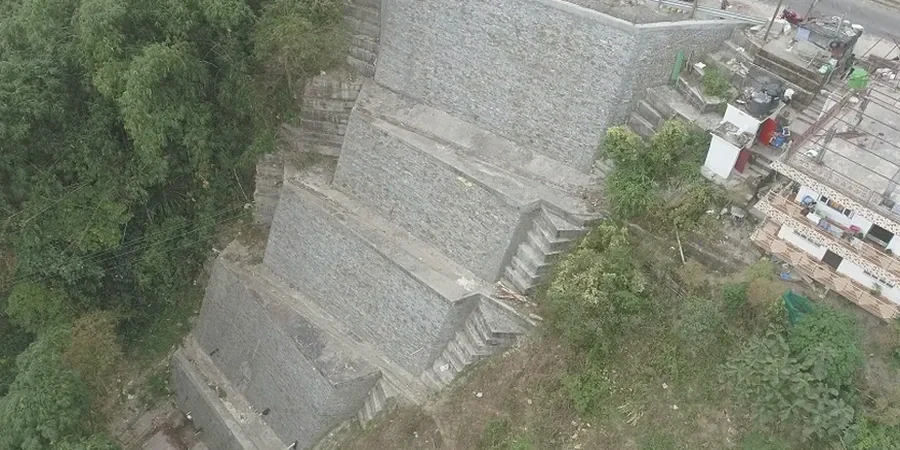
For projects incorporating retaining walls, we evaluate the composite stability of the soil-wall system under drained and undrained conditions. This includes assessing the global failure surface that may pass beneath the wall, a failure mode that isolated wall design often overlooks.
Typical parameters
Quick answers
What is the typical cost range for a slope stability analysis in Providence?
The investment typically ranges from US$1,450 for a screening-level analysis of a simple embankment to US$4,250 for a comprehensive, code-compliant study involving multiple cross-sections, seismic loading, and parametric sensitivity on a complex natural slope. The scope of field investigation required—whether we need supplemental CPT soundings or laboratory triaxial testing—is the primary cost driver.
When does the IBC require a slope stability analysis?
IBC Section 1803.5.3 triggers the requirement when a structure is sited on or adjacent to slopes steeper than 1 unit vertical in 3 units horizontal (33%). The analysis must demonstrate a minimum factor of safety of 1.5 for static conditions, and if the site is in Seismic Design Category C or higher—which all of Providence is—a pseudo-static analysis is also mandatory.
How do you account for the variable fill thickness common in downtown Providence?
We cross-reference historical maps and LIDAR data with direct subsurface exploration, usually test pits for shallow fill profiling or SPT borings for deeper deposits. The fill's drained friction angle is back-analyzed from standard penetration resistance, and we apply a conservative Ru coefficient to simulate the elevated pore pressures that frequently develop in these uncontrolled materials.
Can you analyze slopes in the glacial till that underlies much of the East Side?
Absolutely. The dense, overconsolidated till found on College Hill and the East Side presents a brittle failure mode that requires a peak-to-residual strength reduction approach. We sample the till matrix and perform large-direct-shear tests to capture the influence of cobbles on the bulk friction angle, then model progressive failure using strain-softening parameters.
What deliverable do I receive at the end of the analysis?
You receive a sealed geotechnical report containing the full analytical output: critical failure circle plots, a stability summary table with calculated factors of safety for each section, pore-pressure assumptions, input soil parameters with their source, and a clear statement of conformance with the Rhode Island State Building Code. The report is prepared by a licensed Professional Engineer registered in the state.