Providence sits at the head of Narragansett Bay, where the geology shifts abruptly within a few hundred feet: dense glacial till on the East Side gives way to soft, compressible estuarine deposits along the Woonasquatucket and Moshassuck river corridors. Any deep foundation or ground improvement scheme here has to contend with that transition. Stone column design offers a way to reinforce weak zones without over-excavating, but the column spacing, diameter, and stone gradation depend entirely on how the native silts and peats behave under load. When the upper 15 feet of a downtown site consist of loose urban fill over organic silt, a standard vibro-replacement assumption will not cut it. Site-specific lab data—sieve analyses, consolidation curves, and triaxial shear on undisturbed samples—drives the final layout. For projects near the port or in the Jewelry District, where groundwater is barely 6 feet below grade, we often pair the column design with a deep excavation monitoring plan to verify that adjacent historic party walls stay within allowable settlement limits.
A Providence stone column design lives or dies by the gradation of the imported stone and the undrained shear strength of the native silt.
Our approach and scope
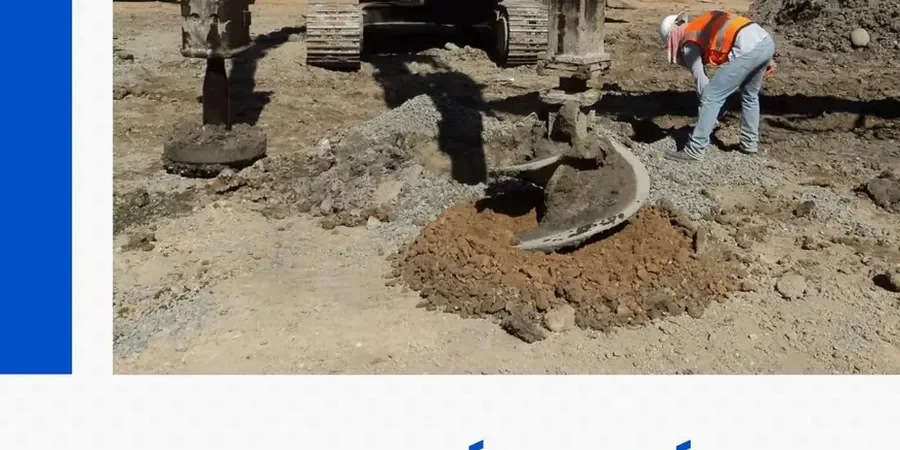
Site-specific factors
Providence enforces compliance with the Rhode Island State Building Code, which incorporates IBC 2021 and references ASCE 7 for seismic design. This is not a paperwork formality in a city where old mill foundations, buried timber cribbing, and undocumented fill blanket large portions of the West End and Olneyville. A stone column design that ignores lateral spreading potential or drainage paths through the improved mass can create a permeable conduit that concentrates groundwater flow against a basement wall two lots over. Adjacent settlement claims are the number-one dispute trigger in Providence infill projects. The design must include a realistic prediction of radial displacement during column installation and a monitoring protocol tied to pre-construction condition surveys. When the treatment zone extends within 20 feet of a historic masonry structure, the column installation sequence and vibration limits become as critical as the bearing capacity calculations themselves.
Video overview
Relevant standards
ASTM D6913/D6913M — Particle-size distribution of soils, ASTM D1586/D1586M — Standard penetration test (SPT) and split-barrel sampling, ASTM D5778 — Electronic friction cone and piezocone penetration testing, ASTM D4767 — Consolidated undrained triaxial compression test for cohesive soils, IBC 2021 / ASCE 7-22 — Seismic ground motion and foundation design requirements
Related services
Geotechnical Investigation for Column Design
Rotary wash borings with SPT and Shelby tube sampling through the full depth of the compressible stratum. Laboratory program includes consolidation, triaxial, and grain-size testing to define the input parameters for column spacing and load-settlement analysis.
Analytical Modeling and Layout Optimization
Axisymmetric unit-cell modeling using Priebe’s method and finite element verification for non-uniform grids. Deliverables include column diameter, area replacement ratio, stone specification, and a sequenced installation plan keyed to the site’s underground utility map.
Post-Installation Verification Testing
Modulus load tests on individual columns and CPT soundings between columns to confirm density improvement. Settlement plates and inclinometers installed as needed for long-term performance monitoring during structural loading.
Typical parameters
Quick answers
How do Providence’s glacial soils affect stone column performance compared to other New England cities?
The biggest difference is the presence of varved clay and silt layers deposited in glacial lakes that once covered the Providence basin. These varves have alternating fine-sand and clay seams that create preferential drainage paths. A stone column installed through varved soil can actually accelerate consolidation by providing vertical drains, but the column design must account for the risk of fine particle migration into the stone matrix. We run filter compatibility checks between the native soil and the proposed stone gradation—a step that is often skipped in cities with more uniform marine clays.
What is the typical cost range for stone column design and testing in Providence?
For a typical Providence site, the combined geotechnical investigation, laboratory testing, engineering analysis, and verification testing package generally falls between US$1,630 and US$5,310. The spread depends on the number of borings required, the depth of the compressible zone, and the extent of the laboratory program—a full triaxial suite on multiple samples costs more than a basic index-test package, but it pays for itself in column count optimization.
Can stone columns be installed year-round in Providence given the winter freeze and spring thaw cycles?
Yes, with proper planning. The working pad needs to be graded and stabilized to support the vibroflot rig during the mud season in March and April. Ground freezing rarely extends below 30 inches in Providence, so the treatment depth is unaffected. The main winter constraint is the stone stockpile: material must be free-draining and kept ice-free to avoid bridging in the hopper. We typically specify a covered stockpile and limit installation during sustained temperatures below 15°F to protect the hydraulic systems on the rig.