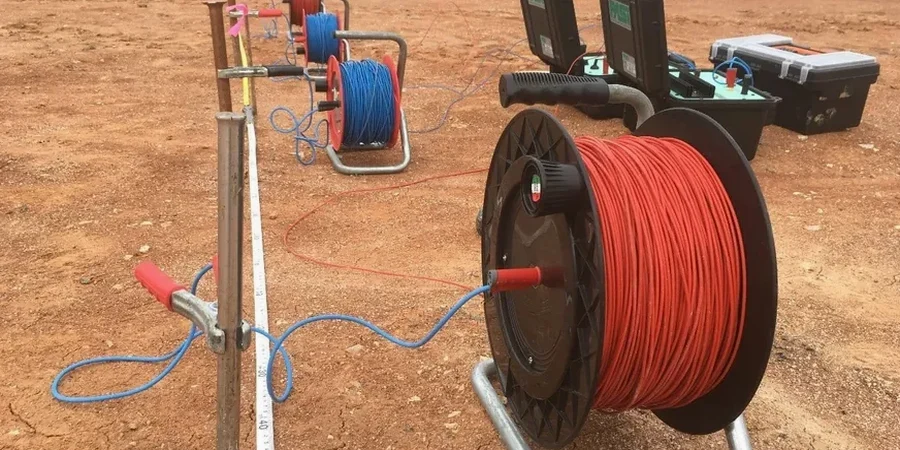
A developer near the Woonasquatucket River recently needed to confirm bedrock depth before driving piles for a five-story mixed-use building. Standard borings showed refusal at inconsistent elevations, so the project team brought in a vertical electrical sounding survey to map the rock profile continuously between boreholes. Providence presents these challenges often — buried valleys, fill over estuarine deposits, and erratic depths to the Rhode Island Formation bedrock. The VES resistivity method sends DC current into the ground through four electrodes, measuring apparent resistivity at expanding spacings to build a layered geoelectric model of the subsurface. For sites in Federal Hill or along the Providence River, where historical fill masks natural stratigraphy, combining resistivity with targeted SPT drilling gives engineers a complete picture of soil stiffness and depth to competent bearing strata without excessive invasive testing.
A single VES sounding in downtown Providence can map the fill-to-bedrock contact across a 100-foot depth interval in under two hours — without breaking ground.
Our approach and scope
Site-specific factors
Providence winters force a short field season for surface geophysics — frozen ground from December through February increases contact resistance dramatically, and electrode coupling becomes unreliable even with brine solutions. The bigger risk for developers, though, is skipping resistivity work in areas underlain by the buried Smith Hill glacial channel. This paleovalley, carved into Carboniferous metasediments and backfilled with soft organic silts, varies from 20 to over 100 feet deep across a few city blocks. A conventional boring program spaced every 100 feet can miss the channel edges entirely, leading to differential settlement claims two years after occupancy. Our team schedules VES work in March through November, but we run winter surveys with heated electrode stations when project timelines demand it — the resistivity contrast between frozen crust and thawed subgrade is actually measurable and correctable in inversion models.
Relevant standards
ASTM D6431 — Standard Guide for Using the Direct Current Resistivity Method, ASTM D2487 — Classification of Soils for Engineering Purposes, Rhode Island State Building Code (IBC-based, with seismic provisions)
Related services
1D Vertical Electrical Sounding (VES)
Single-location resistivity depth profiling for foundation investigation, bedrock mapping, and groundwater table delineation. Ideal for sites where access limits horizontal profiling — tight lots in College Hill or Fox Point. Includes apparent resistivity curves, layered earth inversion, and correlation with available boring logs.
2D Electrical Resistivity Tomography (ERT)
Multi-electrode resistivity imaging along a survey line for mapping lateral variations in fill thickness, contaminant plumes, or karst features. Used for road widening projects along Route 146 and for pre-excavation assessment near existing utilities in the Jewelry District.
Typical parameters
Quick answers
How much does an electrical resistivity survey cost in Providence?
A single VES sounding in the Providence metro area typically runs between US$590 and US$1,200, depending on maximum depth of investigation and site access conditions. 2D resistivity tomography lines start around US$1,800 for a 200-foot transect. We provide fixed-price proposals after reviewing the site location and project objectives — no hidden charges for report revisions or data reprocessing.
Can resistivity testing work on paved sites in downtown Providence?
Yes, though it requires adjustments. On asphalt or concrete, crews drill small pilot holes through the pavement at each electrode position and use a bentonite slurry or saltwater gel for coupling. The contact resistance reads higher than on bare soil, but modern resistivity meters compensate for this. We have completed VES soundings in parking lots adjacent to the Providence Place mall and on compacted gravel staging yards with good results.
What depth can a VES survey reach in Rhode Island glacial soils?
Practical investigation depth depends on the maximum current electrode spacing (AB/2). With AB/2 extended to 150 meters — feasible in open lots or along utility corridors — the effective depth of investigation reaches roughly 30 to 50 meters below grade, enough to penetrate through glacial till and into the underlying Rhode Island Formation bedrock across most of Providence County.