The combination of saturated marine clays along Narragansett Bay and dense glacial till deposits across College Hill forces a dual-minded approach to flexible pavement design in Providence. Winter brings freeze-thaw cycles that push fine-grained subgrades to the surface, while summer humidity works moisture deep into the granular base. A pavement section that performs well in Fox Point might fail entirely two miles west near Olneyville, where the underlying soil shifts from well-drained outwash to compressible organic silts. Our methodology integrates the CBR road testing data directly into layer coefficient selection, ensuring the structural number reflects actual subgrade conditions rather than generic assumptions. For projects on former industrial fill along the Woonasquatucket corridor, we also cross-reference results with grain-size analysis to verify drainage compatibility before locking the base course specification.
A pavement is only as good as its weakest spring-thaw week. In Providence, that week comes every March.
Our approach and scope
Site-specific factors
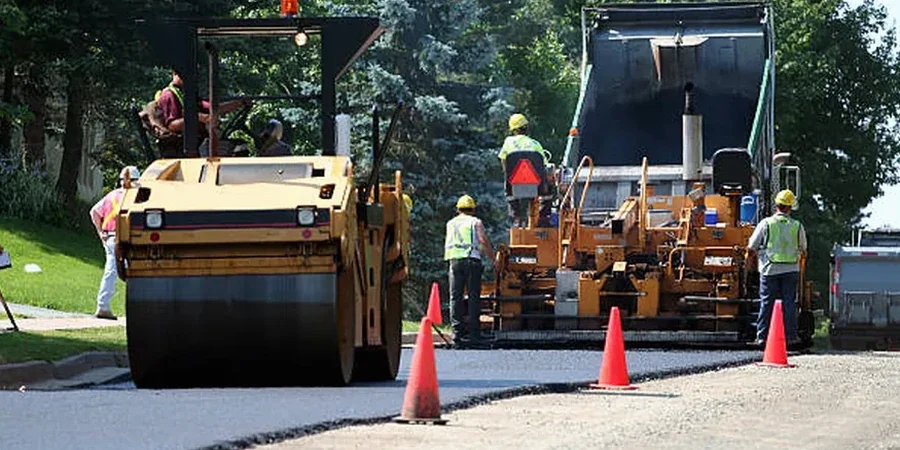
A strip mall re-paving project on Allens Avenue went sideways three years ago because the design assumed a uniform silty sand subgrade. Core samples later revealed a lens of Narragansett Bay organic silt at the east end of the lot, saturated and undrained. The asphalt cracked transversely within two winters, and the owner paid double the original cost to mill, stabilize, and re-pave. That lens was only four feet thick, but it sat directly beneath the wheel path of delivery trucks. A single test pit or DCP sounding at that corner would have flagged the problem. In Providence, the risk is rarely uniform subgrade failure: it is a localized weak spot that expands during freeze-thaw, creating a maintenance sinkhole that grows every March.
Relevant standards
AASHTO Guide for Design of Pavement Structures (1993, with 1998 supplement), ASTM D1586 – Standard Test Method for Standard Penetration Test (SPT) and Split-Barrel Sampling, ASTM D2487 – Practice for Classification of Soils for Engineering Purposes (Unified Soil Classification System), ASTM D1883 – Standard Test Method for California Bearing Ratio (CBR) of Laboratory-Compacted Soils, ASTM D4695 – Guide for General Pavement Deflection Measurements (FWD calibration)
Related services
Structural Section Design
Layer thickness and material specification using AASHTO 93 equations calibrated to Providence subgrade conditions, with seasonal drainage coefficient adjustments and mechanistic checks against tensile strain at the bottom of the asphalt layer and compressive strain on top of the subgrade.
Subgrade Evaluation & Stabilization
In-situ CBR, DCP, and resilient modulus testing along the full alignment, with lime or cement stabilization recommendations for the marine clay pockets common in lower-lying areas near the Providence River.
Typical parameters
Quick answers
What's the typical cost range for a flexible pavement design in Providence?
For a standard commercial parking lot or residential street segment in Providence, the design package typically ranges from US$1,460 to US$5,760 depending on alignment length, number of soil borings required, and whether traffic data needs to be collected from scratch. Projects involving RIDOT coordination or non-standard loading (bus terminals, heavy truck yards) fall toward the upper end.
How does Providence's winter affect the asphalt design?
The freeze-thaw cycling between December and March is the controlling factor. We design the base and subbase layers to drain freely so that water never pools and freezes beneath the asphalt. The asphalt binder grade is also specified for the low-temperature performance grade required in southern New England, typically PG 64-28, to resist thermal cracking during cold snaps.
What thickness of asphalt do Providence commercial lots typically need?
It depends entirely on the subgrade CBR and the expected truck traffic. A light-duty lot with car traffic only may need 3 to 4 inches of HMA over 8 inches of base, while a loading dock area servicing daily tractor-trailers can require 5 to 6 inches of HMA over 12 inches of base, plus a stabilized subbase layer if the underlying soil is the typical Providence glacial till with silt lenses.