Providence sits on a complex glacial legacy that defines every excavation and foundation in the city. From the compacted till beneath College Hill to the softer estuarine deposits along the Providence River, the subsurface conditions shift dramatically within a few blocks. The city’s historic mill districts and new waterfront developments both demand a precise understanding of soil behavior under load. A standard penetration test or simple index property often falls short when engineers need to model how a saturated silt will behave during a hurricane storm surge or under the sustained weight of a steel-framed structure. For these scenarios, the triaxial test provides the controlled stress environment that replicates field conditions in the lab, yielding the drained and undrained shear strength parameters that structural designers depend on. We run these tests to support deep foundation analysis on projects ranging from Jewelry District renovations to infrastructure upgrades near the Port of Providence.
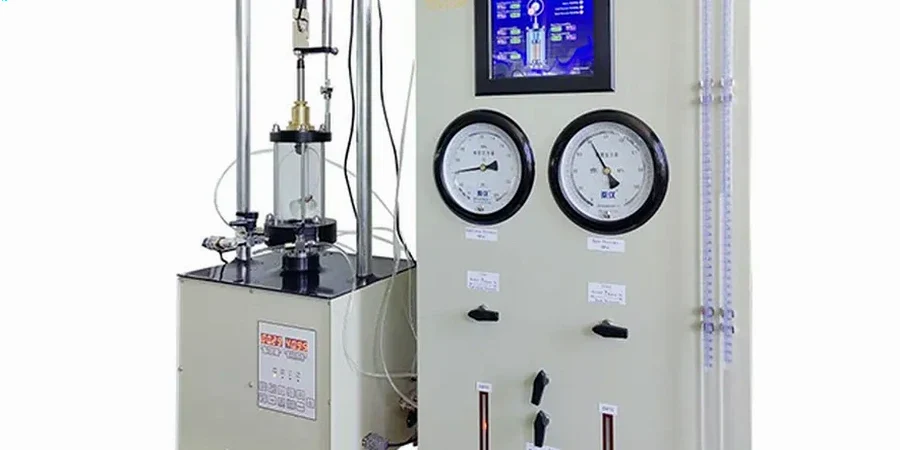
A triaxial test on Providence glacial silt reveals the effective friction angle and cohesion that standard field tests simply cannot measure.
Our approach and scope
Site-specific factors
In Providence, we often observe that the thin layer of desiccated crust on glacial till gives a misleading sense of strength during a site walk. Below that crust, the natural moisture content can jump sharply, and a triaxial test run on an undisturbed Shelby tube sample will show a significant drop in effective cohesion as strain accumulates. The biggest risk in a triaxial program is specimen disturbance during sampling and transport. Providence’s dense urban environment means that vibration from nearby traffic or pile driving on an adjacent lot can disrupt a sensitive clay sample before it reaches the lab. We mitigate this by using thin-walled tubes advanced with a static push, immediate field sealing, and transport in cushioned carriers. Another common pitfall is testing at a confining pressure that does not bracket the in-situ stress state, which leads to an unconservative failure envelope. Our pre-test sedimentation and back-pressure saturation phase, following the recommendations of Seed and Idriss for cyclic evaluation, ensures that the measured pore pressure response is reliable for liquefaction and slope stability assessments.
Relevant standards
ASTM D4767 (CU triaxial), ASTM D7181 (CD triaxial), ASTM D4220 (sample preservation), IBC Chapter 18 (soils and foundations), ASCE 7 (load combinations)
Related services
Consolidated-Undrained (CU) Triaxial
Performed with pore pressure measurement to define the effective stress failure envelope for short-term loading conditions on saturated Providence Bay clays and silts.
Consolidated-Drained (CD) Triaxial
Slow shearing rate with drained pore pressure response, used for long-term stability analysis of cut slopes and retaining structures in the city’s glacial outwash deposits.
Unconsolidated-Undrained (UU) Triaxial
Quick undrained test for preliminary foundation design in fine-grained soils where immediate strength governs the bearing capacity calculation.
Typical parameters
Quick answers
What does a triaxial test cost for a Providence project?
A standard triaxial test program with three specimens at varying confining pressures typically ranges from US$1,770 to US$2,460, depending on the required strain rate and whether you need CU, CD, or both procedures. The final cost reflects the number of Shelby tube samples and the time required for back-pressure saturation of Providence's low-permeability silts.
When is a triaxial test required instead of a direct shear test?
A triaxial test is specified when the design requires the full stress-strain curve and pore pressure response, particularly for Providence sites with soft estuarine clays where undrained strength controls short-term stability. Direct shear forces a horizontal failure plane, while the triaxial test allows the specimen to fail along its natural plane of weakness, which is critical for the anisotropic glacial tills found in the city.
How long does a triaxial test program take in the lab?
A consolidated-undrained triaxial test set with three specimens typically requires 7 to 10 working days from specimen extrusion to final report. The consolidation phase alone can take 24 to 48 hours per specimen for the low-permeability silts common in Providence, and the shearing stage runs at a controlled rate of 0.001 to 0.05 inches per minute.
Can you test coarse glacial till in a triaxial cell?
Yes, but we restrict the maximum particle size to one-sixth of the specimen diameter per ASTM D4767. For the granular outwash and till with cobbles up to 3 inches, we typically remold the specimen after scalping the oversize fraction or use a larger 2.8-inch diameter specimen to maintain a representative grain-size distribution.
What pore pressure parameter do you report for the triaxial test?
We report the Skempton pore pressure parameter A at failure for each confining pressure, along with the full pore pressure versus axial strain curve. This data is essential for Providence engineers modeling the undrained response of saturated fine-grained soils under rapid loading, such as during a seismic event or a sudden drawdown condition on the Providence River. More info.